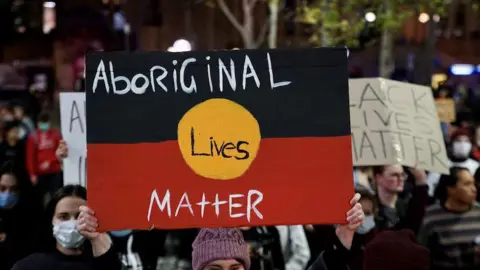
The number of Indigenous people who have died in custody in Australia has hit the highest level since records began in 1980.
New data from the Australian Institute of Criminology showed 33 of the 113 people who died in custody in the 12 months to June this year were Indigenous, up from 24 compared to the previous corresponding period.
Aboriginal and Torres Strait Islander people are disproportionately represented in the criminal justice system, making up more than one-third of all prisoners, despite being less than four per cent of the country's population.
The figures come more than three decades after a landmark inquiry into Indigenous deaths in custody which made hundreds of recommendations.
Of the 33 Indigenous deaths in custody between last July and this June, 26 died while in prison custody, an increase from 18 in the previous 12-month period.
One died in youth detention and all except one were male.
The remaining six Indigenous deaths in custody happened in police custody, where someone has died while police were detaining or attempting to detain them.
The main cause of Indigenous deaths was categorised as self-inflicted followed by natural causes, the report found. Hanging was found to be the cause in eight of the deaths.
The Australian state of New South Wales recorded the highest number of Indigenous deaths in prison custody with nine, followed by Western Australia with six. Queensland, South Australia and the Australian Capital Territory each had three deaths.
The NSW state coroner recently described the rising number of Indigenous deaths in custody in her state as a profoundly distressing milestone.
In October, Magistrate Teresa O'Sullivan said the upward trend was not mere statistics and the deaths needed independent and careful scrutiny, respect and accountability.
The average age of Indigenous deaths in custody was 45 years, and 11 of those who died were awaiting a sentence.
University of Melbourne associate professor of criminal law Amanda Porter told the Australian Broadcasting Corporation (ABC) that the figures reflected a national crisis that required leadership and political action.
Ms. Porter, who has attended several coronial inquests with families of those that have died, said little had changed since the royal commission in 1991 that aimed to address the crisis.
It's maddening to see the number of inquests that I attend, the number of funerals that families have to attend, and the fact that we are 30 years after the royal commission, and the situation is getting increasingly worse, she told the ABC.
Since the royal commission, 600 Indigenous people have died in custody, which includes six in youth detention, the report said.