In a world where sight is often equated with strength, blind Indian athletes Rakshitha Raju and Simran Sharma are rewriting the narrative of capability and achievement in sports. Their journeys are not just about medals; they are a powerful testament to overcoming societal prejudices, personal struggles, and the strength found in camaraderie with their guide runners.
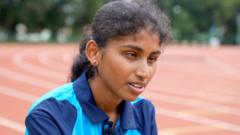
At just 24, Rakshitha is already a trailblazer, being the first blind Indian woman to compete in the 1500m at the Paralympics. "When I was growing up, everyone would say, 'She is blind, she is a waste,'" she remembers wistfully. From a small village in southern India, where both her parents passed away by the age of 10, her life was shaped largely by her grandmother, who is both hearing and speech impaired. This shared understanding of disability fostered a bond that empowers them both.
Rakshitha's path to athletic success began when a sports teacher recognized her potential. "I wondered how I could run on a track I can't see," she recalls. However, she learned about guide runners, and soon, she was being supported by fellow students. In 2016, her fortunes changed when middle-distance runner Rahul Balakrishna took her under his wing. Rahul, who recognized a shortage of guides for athletes like Rakshitha in India, opted to dedicate himself to both coaching and guiding her.
The bond between Rakshitha and Rahul grew stronger over time, built on trust and mutual respect. "I believe in my guide runner more than myself," she states emphatically. Their teamwork has yielded impressive results, winning gold medals at the 2018 and 2023 Asian Games, returning to a hero's welcome in her village, where those who once taunted her now cheer for her achievements.
In contrast, Simran Sharma found herself charting a different course as a partially sighted athlete. After realizing that she needed a guide runner to succeed at the Tokyo Paralympics, her search took time due to the crucial need for synchronization in running techniques. Eventually, she teamed up with Abhay Kumar, another young athlete eager for the experience. Their journey began with challenges—an embarrassing disqualification at the World Para Athletics Championships. However, they soon adapted and struck gold in the 200m, cementing Simran's place in historical achievement as the first Indian woman with a visual impairment to win a Paralympic medal.
Despite the successes, both athletes face unique obstacles concerning the support structures in place for guide runners. While Rakshitha and Simran boast sponsorship deals, their guides, Rahul and Abhay, seek better recognition and support for their roles, which currently lack long-term career prospects and financial backing. The Paralympic Committee of India has stated that guide runners can receive basic necessities but are not eligible for salaries or cash prizes, which leaves them in uncertain futures.
Both Rakshitha and Simran are driven by their aspirations for the next Paralympic Games in Los Angeles, aiming not just to compete but to elevate the narrative surrounding athletes with disabilities. Rakshitha hopes to inspire other young athletes from villages, while Simran is determined to "change the color of this medal,” aiming for gold.
As the BBC Indian Sportswoman Of The Year (ISWOTY) Award gears up for its fifth edition, it stands as a reminder of the remarkable achievements of women athletes in India. Rakshitha and Simran's stories reflect resilience, the imperative of support, and the monumental impact of believing in oneself and each other.