In brief
Chemist Chris Kozak believes he has pinpointed the origin of strange blobs appearing along Newfoundland's southern shores, while Canadian authorities continue their investigation into the phenomenon.
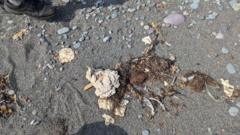
In September, unusual blobs began to wash up on Newfoundland's southern shores, sparking curiosity and concern among locals. Chemist Chris Kozak from Memorial University of Newfoundland has been conducting tests on the mysterious substance, which has a spongy texture and varies in size from a coin to a dinner plate. So far, these globs have appeared consistently along Placentia Bay.Kozak reported that the blobs emitted a petrochemical odor reminiscent of turpentine, leading him to initially suspect polyurethane, a material commonly used in the fishing industry. However, during testing, the blobs sank, which ruled out polyurethane, as it is less dense than water.Further chemical analysis revealed that the blobs are composed of carbon, hydrogen, and oxygen, but notably lack nitrogen and sulfur, pointing to a manmade origin rather than a natural one. The absence of silicon excluded possibilities such as silicone latex or caulking. As the Canadian government's environmental agency continues to investigate the situation, Kozak's findings will aid in understanding the source of these strange occurrences along the coastline.