
In brief
Protests in Tbilisi reach a boiling point, highlighting the nation’s struggle between Western integration and Russian influence, as the Georgian government faces scrutiny over its tactics and affiliations.
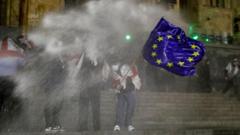
The article text:Georgians have taken to the streets for five consecutive nights, transforming Rustaveli Avenue into a sea of blue and gold EU flags alongside the red and white of the George Cross. The protesters, frustrated with their government’s shift toward Russian loyalty, accuse the ruling party, Georgian Dream, of abandoning their European aspirations.Georgian Dream refutes connections to Russia; however, their recent decisions have sparked heavy criticism and concern about the nation's geopolitical future. Following the suspension of Georgia’s strategic partnership with the U.S. and a deteriorating relationship with the EU, the atmosphere is charged. A Georgian Dream supporter remarked that the nation is perched on "the edge of an abyss."The protests have been punctuated by the loud sounds of vuvuzelas, whistles, and fireworks directed at the parliament building, where riot police have employed water cannons to control the crowd. Reports reveal over 100 police injuries, and numerous protesters have faced severe beatings while detained. Estimates from legal representatives indicate uncommon levels of violence against demonstrators.Levan Ioseliani, Georgia's public rights defender, condemned the police's "brutality" and abuse of power, while government advocates argue that police are merely responding to escalating protests and violence from demonstrators. The ongoing turmoil presents a constitutional crisis, leaving both sides determining whether to assert themselves or retreat in light of public dissent.Prime Minister Irakli Kobakhidze has dismissed the prospect of negotiations, claiming foreign funding for protests—a claim that critics have labeled unfounded. Enthusiastically standing against government policies, one couple vowed to rally every night in December until the ruling party agrees to new elections.In the fallout from a contentious election marred by alleged violations, the opposition deems the ruling party as lacking validity. The rivalry continues as both factions accuse each other of illegitimacy and attacking foundational democratic values. Amid the backdrop of protests, opposition leader Nika Gvaramia asserted that Georgians face a critical juncture: choosing between a European future or succumbing to Russian influence.Similar themes of dissent have echoed throughout Tbilisi, where anti-Russian sentiment resurges, as evidenced by graffiti proclaiming a robust “No to Russia” across the city. Protests symbolize more than opposition to the government; they represent a unified stance against perceived Russian encroachment and insidious influence.Framed amid the ongoing conflict with Russia, the Georgian public remains vigilant, with many fearing they are losing their country. Gvaramia emphasized the importance of long-lasting protests aimed at unraveling the current government's hold on power.In a surprising development, the Georgian Prime Minister announced that engagement with the European Union would not be on the agenda for the next four years, remarks that triggered a strong reaction from Moscow while igniting fears typically associated with Ukraine's crisis in 2014.Georgia's persistence in pursuing democracy and independence seems precarious as winter sets in, but nightly protests show no signs of diminishing. Citizens across the country, including Batumi, Zugdidi, and Kutaisi, converge to express their feelings, striving for recognition in a political climate increasingly veiled in uncertainty and contention.The future remains unclear for Georgia, caught in a tug-of-war between internal governance and external pressures, with calls for free and fair elections echoing louder as protests evolve into a sustained plea for accountability. Meanwhile, proponents on both sides of the conflict persist in their narratives, clinging to vastly different visions of what lies ahead.


