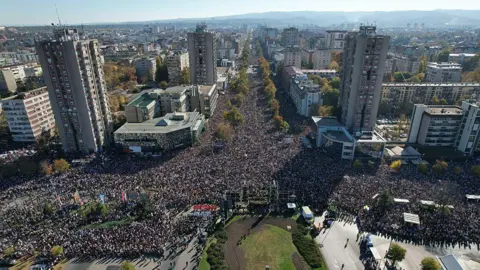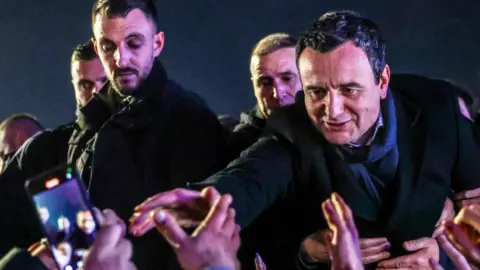
The Albanian nationalist Vetevendosje party has won a landslide victory in Kosovo's parliamentary elections, according to preliminary results.
With 90% of the votes counted, the party, whose name means self determination, was on 50.8%, meaning a third term in power for its leader, Albin Kurti.
The two main opposition parties, the centre-right Democratic Party of Kosovo (PDK) and the Democratic League of Kosovo (LDK), were on 20.98% and 13.89%, respectively.
Vetevendosje won elections in February, but without a majority, and Kosovo has been without a functioning government since then.
The impasse meant there was one big question hanging over this second parliamentary election of the year. Would voters punish Kurti for the long months of deadlock in the country's National Assembly – or the opposition parties who refused to countenance a coalition with Kurti's left-wing movement?
The electorate has given a clear answer. This will not be quite enough to deliver enough seats for Kurti to govern without coalition partners, but he should not find it difficult to find support among the MPs from the ethnic minority parties who are guaranteed 20 of the 120 seats in the National Assembly.
It is the fourth successive victory for Vetevendosje. The result is vindication after the opposition parties blocked his attempts to form a government following the previous polls on February 9.
Kurti claimed it was the greatest victory in the history of the country – and said he expected opposition parties to cooperate, rather than frustrate, this time around.
There is plenty at stake. Kosovo has missed out on hundreds of millions of euros' worth of European Union funds because of the lack of a functioning government. Kurti also cited potential agreements with the World Bank which would bring the total sum to more than €1bn.
Repairing relations with Kosovo's strongest international supporters, the EU and the US, should also be on the agenda. Kurti angered Brussels and Washington by repeatedly targeting institutions serving Kosovo's Serb minority – from post offices to healthcare facilities.
The EU has finally agreed to remove the punitive measures it imposed in 2023 but will be looking for Kurti to take a pragmatic approach to the long-stalled normalisation dialogue with Serbia.
One analyst noted Vetevendosje's countless violations of the constitution and the breakdown of relations with allies. However, citizens have considered the opposition to be more harmful.