In brief
Amid devastating losses from recent Russian drone and missile strikes, Ukraine is enhancing its air defense systems through innovation and the deployment of cost-effective interceptor drones. With a significant uptick in the effectiveness of Ukraine's defenses, the country is now capable of intercepting a large percentage of threats, although challenges remain in fully securing its skies.
This week, with air raid warnings wailing in the distance, Kyiv held a funeral for two sisters.
12-year-old Liubava and her 17-year-old sister Vira were among 24 civilians killed by a Russian missile which reduced their residential block to rubble earlier this month. They had already lost their father who had been fighting on the front line. Their grieving mother is now the family's sole survivor.
This is the human cost of the largest sustained Russian aerial assault so far – with 1,500 drones and 56 missiles fired at Ukraine within 48 hours.
But the loss of life could have been even higher. Ukraine's air defences prevented more casualties. According to President Volodymyr Zelensky, 94% of those long-range drones and 73% of the missiles were successfully intercepted. In comparison, on 14 May 2025, Kyiv's forces took down 55% of Russian drones launched nationwide. Ukraine is getting better at defending its skies.
We are now, unfortunately, the best in the world, says Lt Col Yuriy Myronenko, an inspector general at Ukraine's Ministry of Defence. He admits, though, that shooting down Russia's ballistic missiles is not so easy.
More than four years on from Russia's full-scale invasion, Ukraine has built an increasingly sophisticated, layered air defence system. At the start of the war, it relied on old Soviet-era weapons. The West then helped bolster its defences with expensive, more sophisticated systems including Patriot air defence missiles.
But Ukraine has also been developing its own home-grown solutions – from mobile fire teams operating heavy machine guns on trucks to cheap, mass-produced interceptors.
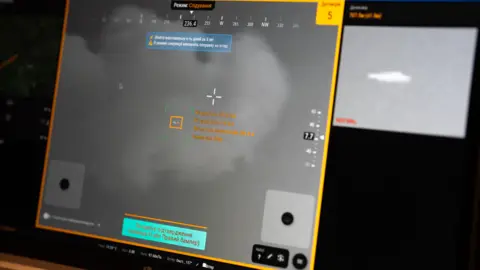
Embracing innovation and technology is giving Ukraine an advantage. At the heart of Ukraine's air defences is the software that tracks every glide bomb, missile, and drone launched by Russia. Sky Map uses radars, thousands of sensors and video feeds, and artificial intelligence to detect threats and guide its air defences.
To start with, Ukraine relied on a network of mobile phones fitted on to telegraph poles to listen out for the sound of approaching drones. Now the system uses more sophisticated sensors.
And there's one weapon, more than any other, that's helping take down Russian drones: cheap interceptor drones. They are shaped like a large bullet and propelled by four rotors at the base. Ukraine is now producing more than 1,000 of these kinds of drones a day. In March this year, they destroyed more than 30,000 Russian drones, according to Ukraine's air force.
Welkos, the commander, calls it a very serious weapon. It shows how quickly we can adapt, how we can hold the line and how much we can develop, he says. The P1-SUN is 3D-printed and costs around $1,000 (£750) – much less than the large $50,000 delta-winged Shahed one-way attack drones that it is designed to destroy.
Private companies are plugging into the system too. Twenty-five companies have already signed up to provide air defense solutions to protect their infrastructure. Companies like Carmine Sky have built systems that include remotely controlled machine guns to increase defensive capabilities.
Despite the advancements, glaring gaps remain in Ukraine's air defenses, especially when it comes to high-tech missile interceptors. President Zelensky has warned that Russia's mass attacks are designed to overwhelm its air defences, reinforcing the urgent need for continued innovation and support in securing Ukraine's skies.