We're driven blindfolded to a secret location where Ukraine is making one of its latest weapons.
We're told to turn off our phones - such is the secrecy around the production of Ukraine's Flamingo cruise missile.
For Ukraine, dispersing and hiding the production of weapons like this is key to survival. Two factories belonging to the company that make it - Fire Point - have already been hit.
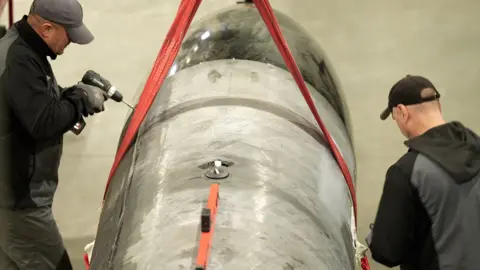
Inside the one we're visiting we're told not to film any features such as pillars, windows or ceilings. We're also asked not to show the faces of workers on the assembly line - where Flamingo missiles are at various stages of completion.
Even under fire, Ukraine is ramping up its arms industry. President Volodymyr Zelensky says the country now produces more than 50% of the weapons it uses on the front line. Almost its entire inventory of long-range weapons is domestically made.
At the start of the war, Ukraine mostly relied on its old Soviet-era arsenal. Western military support helped modernize the country's armed forces, but it now leads much of the world in developing unmanned systems – like robots and drones.
Now, domestically produced cruise missiles are adding to Ukraine's long-range capability.
Iryna Terekh is the chief technical officer of Fire Point – one of Ukraine's largest drone and missile manufacturers whose Latin motto translates to if not us, then who.
The 33-year-old once studied architecture, but she is now trying to help dismantle the Russian war machine.
She cuts a tiny figure in front of the giant Flamingo missile, which she tells me is painted black not pink (unlike early prototypes) because it eats Russian oil.
The end product looks similar to the German V1 rocket from World War Two. It consists of a large jet engine placed on top of a tube the length of a London bus.
They've already been used in combat, though the company won't confirm specific targets.
The Flamingo is a deep-strike weapon that Western nations have been hesitant to supply. The cruise missile is said to have a range of 3,000km (1,900 miles). That's similar to a US-made Tomahawk – the more sophisticated and expensive weapon that was not provided to Ukraine.
Deep strikes are seen as a crucial part of the war, for which Ukraine mainly uses long-range drones. It continues to lose ground to Russia on a front line that stretches for more than a thousand kilometres. Thus, Ukraine is increasingly focused on targeting Russia's war economy to impede advances.
General Oleksandr Syrskyi states that Ukraine's long-range strikes have already cost the Russian economy more than $21.5 billion this year.
Fire Point didn't even exist before Russia's full-scale invasion. But the start-up is now producing 200 drones a day. Its FP1 and FP2 drones, each the size of a small airplane, have conducted 60% of Ukraine's long-range strikes. Each drone costs around $50,000 – three times cheaper than a Russian Shahed drone.
Ms. Terekh emphasizes that Ukraine is striving for self-sufficiency in its arms production while avoiding critical components from China and the US, concerned about the reliability of foreign support amidst the ongoing war.
Ms. Terekh expresses a hope that European nations will learn from Ukraine's resilience and prepare themselves for any future conflicts.