In brief
The South African government's condemnation of the U.S. decision to prioritize refugees from white Afrikaners comes amidst claims that the narrative of white genocide is unfounded. An open letter from Afrikaner leaders counters claims of persecution, suggesting that the number of applicants seeking relocation to the U.S. is minimal, indicating a lack of real threat. President Trump's administration's refugee cap has also raised concerns and debates over land reforms and what constitutes genuine victimhood.
The South African government has criticized the U.S.'s decision to prioritize refugee applications from white Afrikaners, stressing that the claims of a white genocide have been extensively discredited and lack reliable evidence.
It highlighted an open letter published by notable members of the Afrikaner community earlier this week which dismisses this narrative, with some signatories describing the relocation scheme as racist.
The government pointed out the limited number of white South African Afrikaners signing up to relocate to the U.S., suggesting that they are not facing persecution.
On Thursday, the U.S. administration announced its lowest annual refugee cap on record, set at just 7,500.
Although specific numbers of white South Africans admitted through the U.S. scheme are not available, South Africa's latest crime statistics do not indicate a disproportionate rise in violent crime against white individuals compared to other racial groups.
Earlier this year, President Trump had offered refugee status to Afrikaners, primarily descendants of Dutch and French settlers, following South African President Cyril Ramaphosa's approval of a controversial law allowing the government to seize land without compensation under rare circumstances.
Most private farmland in South Africa is owned by white South Africans, who represent just over 7% of the national population.
The situation escalated months ago when South Africa's ambassador to Washington, Ebrahim Rasool, was expelled after he accused Trump of 'mobilizing a supremacism' and projecting a narrative of white victimhood.
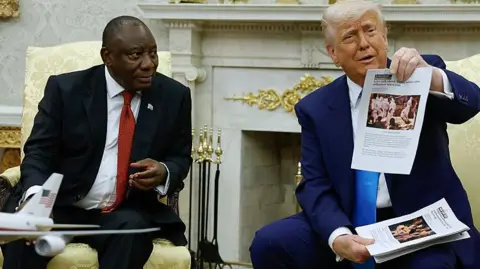
In the Oval Office last May, Trump confronted President Ramaphosa, asserting that white farmers in South Africa were under threat of death and persecution. Trump's administration had showcased graphic videos and images to bolster these claims, later debunked as misrepresentations.
This ongoing dispute continues to fuel discussions about race, identity, and the complexities of land reform within South Africa, reflecting broader sociopolitical dynamics in both nations.