In brief
A Boeing 767-300 cargo plane belonging to Amazon crashed at Miami International Airport on 8 September after overshooting the runway, striking vehicles and catching fire. Pilot Trent Topaz repeatedly alerted his co‑pilot that the aircraft’s speed was excessive, but responses were inconsistent and an altitude alarm was ignored. Flight‑data information shows a landing speed of 158 kn, near the high end, and flap deployment delayed until the final approach. NTSB investigators conclude that miscommunication and procedural lapses contributed to the crash, which killed five crew members and injured five others.
Pilot warned Amazon cargo plane was travelling too fast before deadly crash, flight data shows
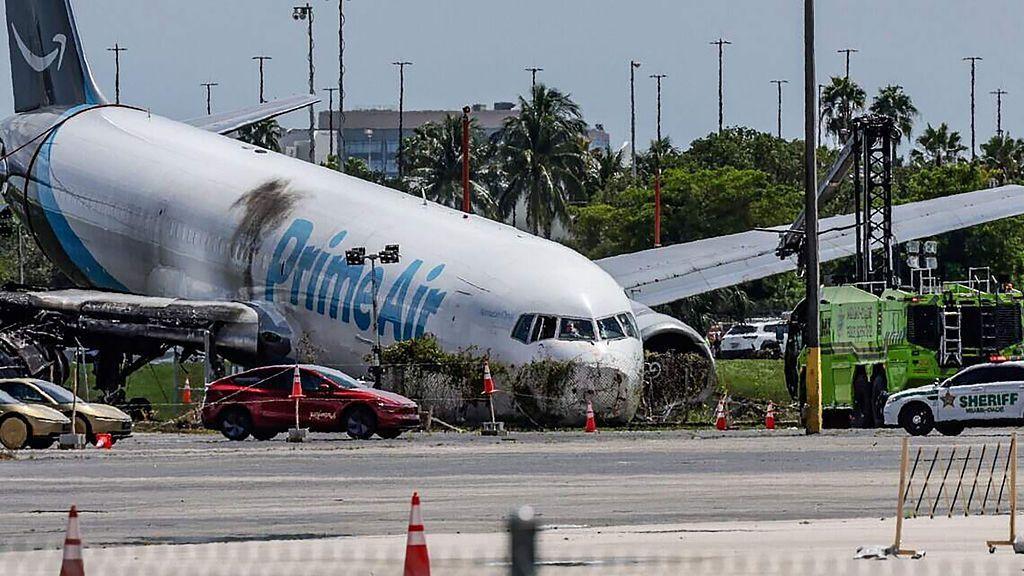
On Sunday the Amazon Prime Air cargo flight 7598, a Boeing 767‑300, crashed at Miami International Airport after overshooting the runway. The aircraft struck a white Ford van and a Toyota Corolla and then broke out of the perimeter fence before coming to rest 1,300 ft (394 m) from the runway end, where it burst into flames.
The pilot in the cockpit repeatedly warned of the plane’s excessive speed. The flight‑data recorder shows that the pilot’s colleague kept calling out the high speed, but verbal replies were not consistent. An automated altitude alarm rang during the final minutes but was ignored.
Landing speed reached 158 knots (292 km/h). That value sits at the high end of the acceptable landing window for a 767‑300.
In addition to speed and speed‑warnings, the NTSB data highlights delayed flap deployment. The largest flap – a crucial help in slowing the aircraft – was deployed much later than expected, suggesting the crew may have been trying to correct the speed problem.
The crash killed five crew members who were part of the plane‑cleaning crew in the van: Rolando Aleman Leon, Yoel Rodriguez Naranjo, Julio C Pineda, Carlos Acosta Fajardo and Javierkys Reyes Quevedo. Five others were injured.
Pb. aviation attorney Pablo Rojas said the incomplete audio record makes it hard to interpret the inconsistent responses, but confirms that the approach was problem‑laden. "The lack of firm communication and the delayed flap deployment suggest an increasingly unsafe situation that may have led to the overrun," he added.
Investigators, led by the US National Transportation Safety Board, continue to probe the cause of this dangerous incident—including why the crew had no clear, unified communication on speed and approach, and whether other operational protocols were breached.
Related topics: aviation safety, Florida, United States, Amazon, aviation accidents and incidents.