In brief
In the wake of the Israel-Hamas ceasefire, children in Gaza are returning to school after years without formal education. Makeshift classrooms are bustling with activity as students, many of whom have faced unimaginable hardships, begin to regain a sense of normalcy. However, the challenges remain steep, with a lack of resources and emotional scars affecting their learning environment.
In Gaza City, the sound of children learning can be heard once again.
The tents that now serve as classrooms are noisy and a little chaotic but lively. Some teachers point to boards covered in English letters; others invite pupils to come forward and write basic Arabic words.
It is nowhere near a normal school day. But after the Israel-Hamas ceasefire in October, it's a start.
After two years of war, the hum of lessons and chatter of classmates resonates around the ruins of what was once Lulwa Abdel Wahab al-Qatami School, in the Tel al-Hawa neighbourhood in southwestern Gaza City.
It was hit in January 2024, and for months afterwards, its grounds served as a shelter for displaced families. Today, it is again a place of learning - albeit in a more basic form.
Walking in a straight line, their small arms resting on each other's shoulders, pupils smile as they head into the makeshift classrooms.
For many, this is the first return to routine and education since the war began.
According to UNICEF, more than 97% of schools in Gaza were damaged or destroyed during the war. The IDF has made repeated claims that Hamas uses civilian infrastructure including schools to carry out operations but has rarely provided solid evidence.
Of the Strip's 658,000 school-aged children, most have had no formal education for nearly two years. During that time, many learned firsthand how hunger, displacement, and death can shape their young lives. Now, something rare is emerging: a fragile glimpse of the childhoods they once knew.
Fourteen-year-old Naeem al-Asmaar used to attend this school before it was destroyed. He lost his mother in an Israeli air strike during the war.
It was the hardest thing I've ever been through, he says quietly.
Although he was displaced for months, Naeem's home in Gaza City survived. After the ceasefire, he returned with his family.
I missed being in school a lot, Naeem said, adding that the difference is stark.
Before the war, school was in real classrooms, now it's tents. We only study four subjects. There isn't enough space. The education is not the same - but being here matters. School fills all my time and I really needed that.
The makeshift school is run by UNICEF and brings together children from the original Lulwa school and others displaced by the war.
It does not teach the full Palestinian curriculum - only the basics: Arabic, English, mathematics, and science.
Despite the effort, demand far exceeds capacity.
As UNICEF's Jonathan Crickx notes, there are significant challenges: Paper, notebooks, pens, erasers, rulers... we've been asking for a long time that these supplies can enter the Gaza Strip and they haven't been allowed in.
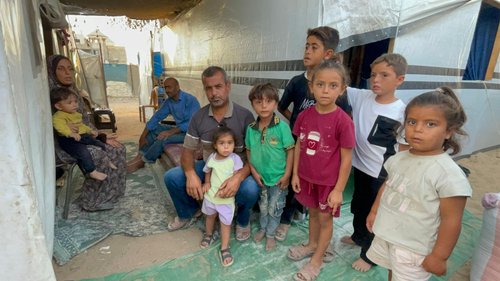
Even with the return to education, many parents express anxiety over the overwhelming challenges facing their children.
For them, hope resides in the potential that education brings—even if it is only a faint echo of what it once was.