In brief
Amid the growing presence of AI in various industries, there is a significant push to create a universally recognized label for products and services that are genuinely 'human-made'. With a multitude of declarations emerging such as 'No A.I.' and 'Proudly Human', this initiative aims to address public concerns about job displacement and the erosion of authentic human creativity. However, experts warn that without a single standard for identification, consumers may face confusion over the authenticity of these labels.
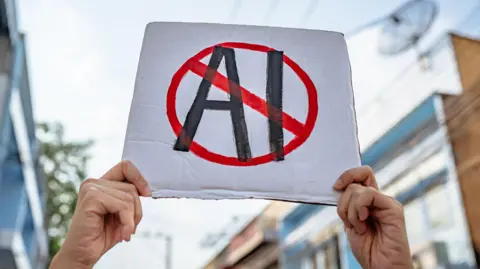
Organizations worldwide are racing to develop a universally recognised label for human-made products and services as part of the growing backlash against AI use.
Declarations like Proudly Human, Human-made, "No A.I" and AI-free" are appearing across films, marketing, books and websites.
It is in response to fears that jobs or entire professions are being swept away in a wave of AI-powered automation.
BBC News has counted at least eight different initiatives trying to come up with a label that could get the kind of global recognition that the Fair Trade logo has for ethically made products.
But with so many competing labels - as well as confusion over the definition of AI-free - experts say consumers are in danger of being left confused unless a single standard can be agreed on.
AI is creating significant disruption and competing definitions of what is 'human made' are confusing consumers, says consumer expert Dr Amna Khan from Manchester Metropolitan University.
A universal definition is essential to build trust, clarification and confidence," she told BBC News.
The movement to create AI-free certification systems follows generative AI tools being used to replace human work and creativity in a range of industries including fashion, advertising, publishing, customer services and music.
The organisations trying to come up with the labels include companies as well as non-profits, based in the UK, Australia and the US.
How the certifications work
Some labels like no-ai-icon.com, ai-free.io and notbyai.fyi, can be downloaded by anyone for free or for a fee without much or any auditing.
Other systems like aifreecert require payment and have a strict process of vetting whether or not a product has used AI or not. Auditors use professional analysts and AI-detecting software.
But AI experts say that getting industries to agree on what truly counts as human made will prove complicated as AI is integrated into so many everyday tools.
Generative AI-free
Some think that the line should be drawn at the use of generative AI - chatbots that create text, code, music or video with human prompts.
In the closing credits of the 2024 Hugh Grant thriller Heretic, producers wrote a disclaimer saying: No generative AI was used in the making of this film.
Film distributor The Mise en scène Company has taken this idea on and recently added a 'No AI was used' stamp to the poster for its latest film which was written, directed and edited largely by one person.
We support the AI industry and we think it’s an exciting time but we think that as a result of AI content there is an economic premium put on human-made content and we want to lean into that, says CEO Paul Yates.
The arts industry is particularly rife with AI-made products and seems to be the current focus for the push back against AI use. Entire books and films are being made with AI far faster and more cheaply than using traditional methods.
Sometimes products that rely on AI don't make that clear to consumers. This was the case last year with the viral band Velvet Sundown that was revealed to be fully AI.
Elsewhere in the book industry, publishing giant Faber and Faber began putting a Human Written stamp onto some of its books. Author Sarah Hall requested the stamp be added to her novel Helm. Hall also described the intellectual property theft of books used to train AI models as creative larceny at scale.
In Australia, competing company Proudly Human uses a similar but even more rigorous system to ensure authors are not using generative AI. Their auditors carry out checks at every stage of publication including checking any changes made from manuscript to ebook edition.